


Generate Research Topics Using AI
The use of artificial intelligence to generate research topics is supported by several established theories of creativity and innovation. Guilford's divergent thinking theory (Guilford, 1967) emphasizes fluency, flexibility, and originality in producing diverse ideas - capabilities that large language models (LLMs) can scale by generating many candidate topics rapidly. Boden's computational creativity framework (Boden, 2004) highlights combinational creativity, the recombination of existing ideas into novel configurations, aligning with knowledge recombination theory in innovation studies (Youn, 2015). Similarly, the Blind Variation and Selective Retention model (Simonton, 2022) describes creativity as generating numerous variations followed by selective evaluation, a process AI can accelerate. Empirical support comes from a large Stanford-led study (Si et al., 2025), which found LLM-generated research ideas to be significantly more novel than those from human experts (p < 0.05), though slightly less feasible.
This human-AI co-creation perspective aligns with recent work that positions generative AI as an augmentative ideation partner rather than a replacement for human creativity, and it is precisely this principle that underpins the design of Gatsbi Innovator as an AI co-scientist in production for research topic/hypothesis generation. Gatsbi Innovator is meticulously designed to mirror human creativity and structured research problem-solving workflows, ensuring that every solution generated is not only novel but also practical and implementable.
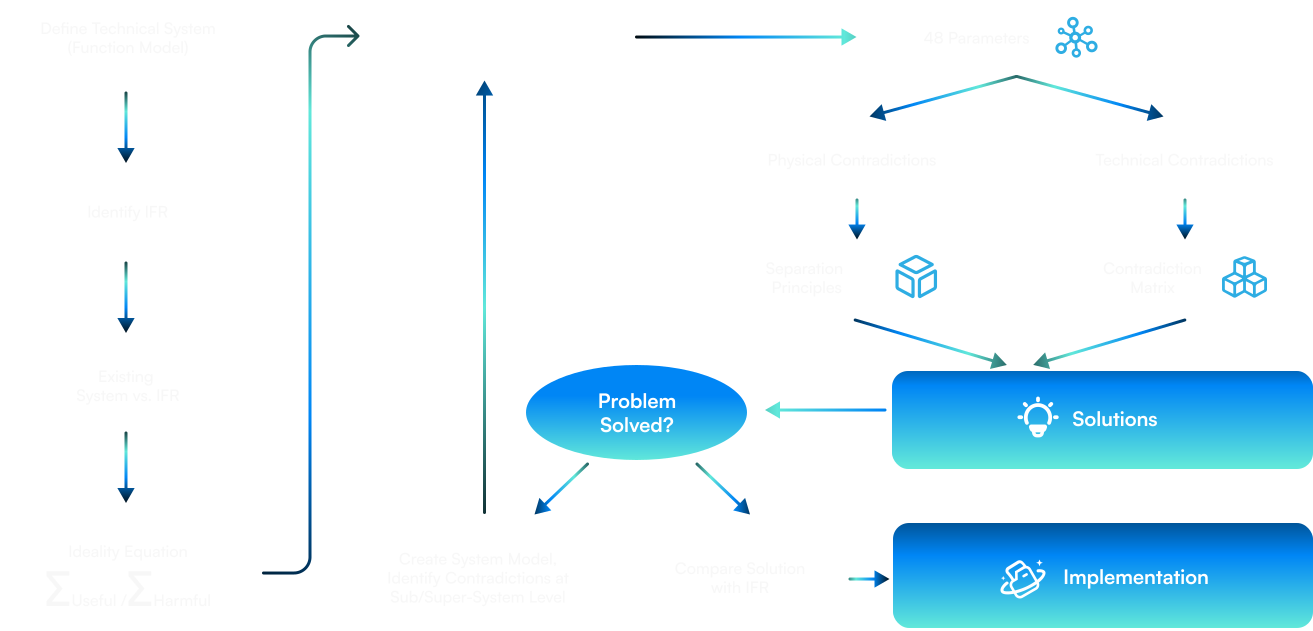
AI That Converts Research Problems into Implementable Solutions

Entering a Research Problem:
Input your research challenge, e.g., "battery life extension".
AI-Driven Systemic Analyses:
Gatsbi will analyze your research problem from different aspects, such as the system and supersystem, components, su-fields, engineering parameters, and contradictions.
Generating Inventive Hypotheses:
Based on the above analyses, Gatsbi automatically proposes 10-20 inventive hypotheses.
Evaluating Novelty and Feasibility:
Gatsbi provides references, novelty scores, and feasibility evaluations with comments for each proposed solution.
Planning Concrete Implementation:
Choose your preferred solution, and Gatsbi will develop its detailed implementation plan.
Who Is Gatsbi Innovator For?
Gatsbi Innovator is designed for STEM researchers, engineers, and technology innovators who need more than a chatbot — they need a product-grade AI Co-Scientist that can reason about complex problems, generate novel hypotheses, and translate ideas into implementable solutions. Inspired by emerging systems such as Google Research’s AI co-scientist — a multi-agent virtual collaborator that helps scientists produce new hypotheses and research proposals — Gatsbi brings similar capabilities into an accessible, production-ready environment for everyday research and innovation work. It is especially valuable for early-stage exploration, interdisciplinary problem solving, and projects where existing knowledge must be recombined into practical designs.
Unlike tools focused only on writing or coding, Gatsbi supports the full innovation cycle: problem formulation, systemic analysis, inventive solution generation, feasibility evaluation, and implementation planning. This aligns with the broader vision of autonomous scientific systems such as Sakana AI’s "AI Scientist", which aims to automate large parts of the research process — from idea generation to experiments and manuscript production. Gatsbi, however, is built as a human-centered co-scientist rather than a replacement: it augments expert judgment, accelerates discovery, and helps translate complex research challenges into actionable outcomes across domains such as materials science, biomedical engineering, energy systems, computing, and advanced manufacturing.
Whether you are an R&D engineer seeking breakthrough designs, a researcher exploring new hypotheses, or a research team pursuing high-impact innovation, Gatsbi Innovator functions as a reliable intellectual partner — scaling creativity, structuring reasoning, and helping turn ambitious scientific questions into real-world solutions.
Frequently Asked Questions
- Gatsbi Innovator is an AI-powered research ideation and innovation tool designed for academic researchers, R&D teams, technology innovators, and inventors who need original, well-structured ideas for further review and development. It uses advanced large language models and human-like research workflows to analyze your problem and propose novel research hypotheses, paper topics, and technical solutions that go far beyond what a normal chatbot can generate.
- You start by entering a focused research topic or problem statement, such as "improving battery life in wearables" or "interpretable large language models." Gatsbi Innovator then runs a multi-step systemic analysis of your topic, including component and supersystem analysis, parameter identification, and contradiction discovery, before generating around 10-20 inventive solution ideas with novelty comments, star ratings, and supporting references. If your topic is too broad, the system suggests more specific, cutting-edge angles so you can quickly align with global research frontiers.
- Yes. For each idea, Gatsbi Innovator provides real, verifiable academic references that you can open directly, rather than made-up or hallucinated citations. These references are sourced from reputable academic databases such as Google Scholar and are selected to ground each suggested idea in existing literature. Even so, users are encouraged to double-check any citation before including it in formal papers, theses, or patent applications, in line with academic best practices worldwide.
- Yes. Once Gatsbi Innovator lists potential research ideas, you can click "Expand" to get a more detailed implementation concept, including how the idea could be executed and evaluated. You can then use the "Explain" option for deeper clarification and seamlessly move into other Gatsbi tools, such as the AI Paper Writer or AI Patent Writer, to draft full research manuscripts or patent disclosures based on the selected innovation.
- Gatsbi Innovator supports a wide range of disciplines, including computer science, artificial intelligence, engineering, physics, biomedical research, and other STEM fields commonly pursued in universities and research institutes worldwide. It performs especially well on specific, technical topics where it can propose concrete mechanisms, models, or system designs, for example "federated learning privacy mechanisms" rather than just "machine learning."
- Partially. You can enter your research topic in many different languages, making Gatsbi Innovator accessible to researchers across regions such as Asia, Europe, and Latin America. The system performs its core reasoning in English for maximum quality, then translates the outputs, explanations, and comments back into your input language so they remain easy to read and use in your local context.
- If you are not happy with the current batch of ideas, you can click "Regenerate" to have Gatsbi Innovator explore additional inventive principles and propose a fresh set of solutions. With a full subscription, the system typically produces around 12-20 candidate ideas per run, giving you wide coverage of possible directions, and you can also refine your topic wording to steer the AI toward more niche or region-specific research problems.
- Gatsbi offers a free 1-day trial of selected core features, allowing new users to test Gatsbi Innovator and other research tools with unlimited sessions during the trial period. After that, access to the complete feature set is available via a paid subscription.